In the dynamic world of business, opportunities are boundless. At Phastivity, we see potential in every challenge. Our strategies are designed to unlock your business’s hidden capabilities, and our innovative solutions drive unparalleled growth. Let’s embark on this journey together.
A user-owned AI assistant that acts across your tools.
Qilo turns natural language into controlled, multi-step actions across the tools professionals already use, running entirely on infrastructure the user controls. I owned it end to end, from concept and research to brand, system design, and the build.
Role
Lead Product Designer
AI Systems Designer
Agent Workflow Builder
Knowledge workers are not blocked by thinking. They are blocked by coordination.
Work lives across email, calendars, documents, and CRMs that do not talk to each other. The user becomes the integration layer between their own tools. The tools that could fix this asked for a shared cloud, which professionals with sensitive data will not accept.
The core tension: capability versus control.
Before / After chart
Before, you connect your apps by hand. After, Qilo does it for you.
The System
An orchestration engine, not a chatbot.
Qilo is not a chatbot layer or an automation tool. It is an execution layer: a request flows through intent interpretation, memory retrieval, reasoning, tool execution, and a confirmation gate before anything irreversible happens.
The entire system runs on a private server that belongs to the user.
All workflows, memory, and tool execution run inside user-owned infrastructure. Only minimal context is sent to the LLM per request.
The Interface
A plugin that takes anything in.
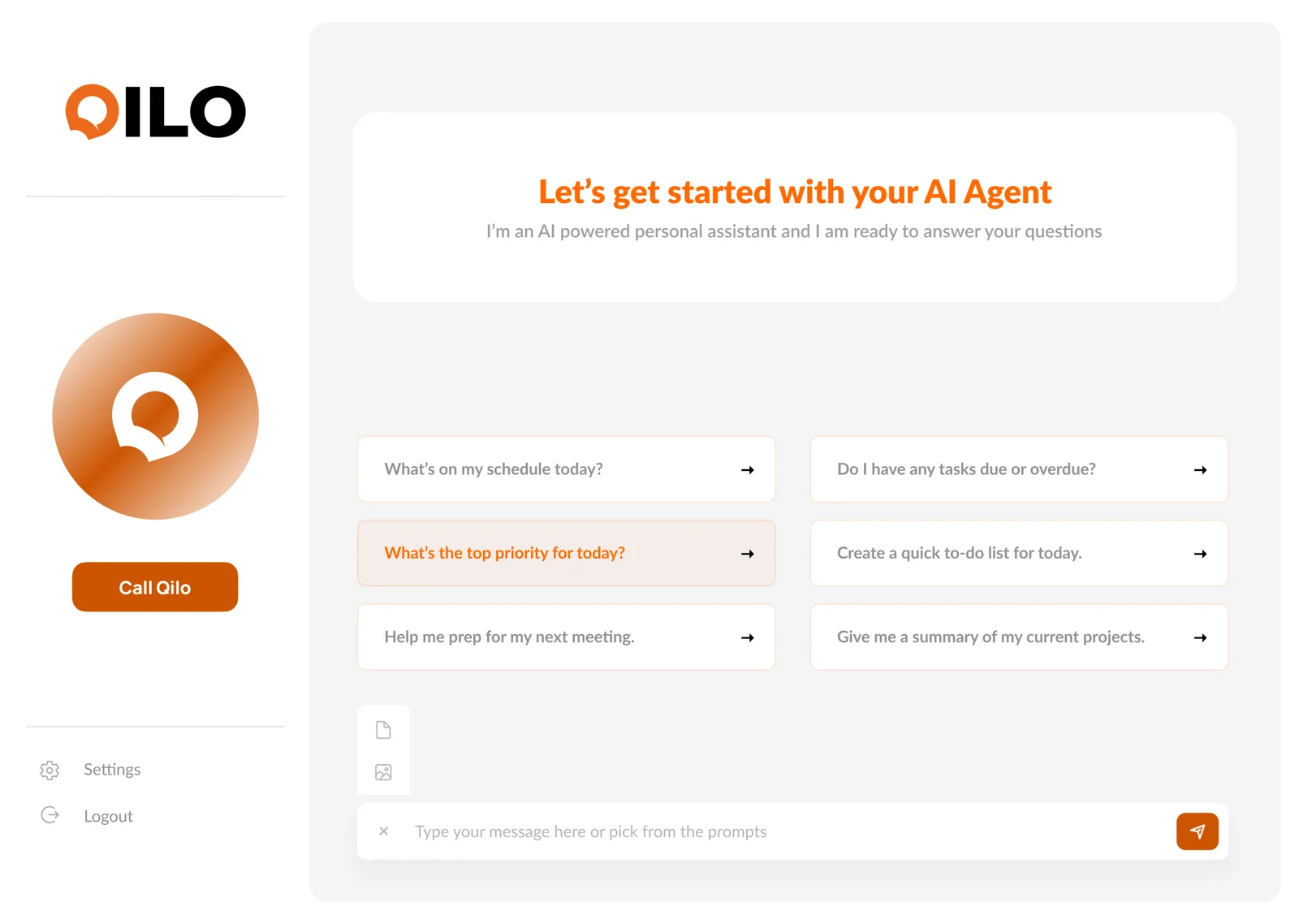
The entry point, built as a WordPress plugin: text, image, file, or voice, bridged straight into the engine.
What I Built
Designed and built in parallel, not handed off.
I owned every layer, from concept, research, and brand through product and system design to the build itself.
Built
Multimodal orchestration backend
An N8N workflow architecture that takes text, image, file, or voice as input, with routing logic from intent to tool execution, modular enough to add new agents without a rebuild.
Built first
Production RAG and memory
Stood up before the agent: a Pinecone pipeline that stores past conversations and user documents, and pulls only relevant context per request.
Built on top
Agent and control model
Layered over the memory, with reasoning and execution kept separate and a confirmation gate so nothing irreversible fires on its own.
Built
Front-end input layer
A custom WordPress plugin as the primary entry point, bridging multimodal input into the engine.
Failed or uncertain steps pause and return to the user before anything downstream continues.
The Website
Built to remove doubt, in order.
Capability, proof, integrations, setup, privacy, then pricing as ownership.
Design System
Restraint as a strategy, not an aesthetic.
The visual system had one responsibility: make an ambitious, technically complex product feel trustworthy. Restraint, white space, and a focused accent system reduce intimidation and reinforce clarity.
A working zero-to-one product, designed and shipped end to end.
The user stops copy-pasting between email, documents, and a CRM. One request replaces several manual context switches by executing structured tool actions across connected systems, all within a single controlled system boundary.
Pre-metric deployment validated through end-to-end functional execution across live tools. Adoption and performance metrics are the next phase.
Qilo
Not an AI assistant.
A user-owned execution layer that turns natural language into controlled actions across private systems.